1
/
of
1
669FDC1- Iceland's Seabed Ecosystem III
669FDC1- Iceland's Seabed Ecosystem III
Regular price
2.040 kr
Regular price
Sale price
2.040 kr
Unit price
/
per
Tax included.
Couldn't load pickup availability
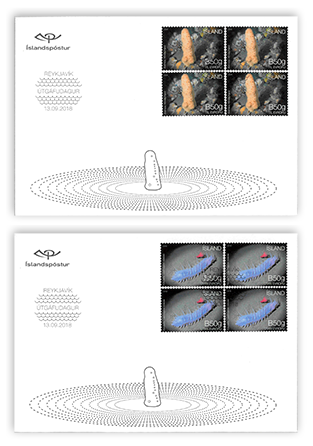
Sponges (Porifera) are multicellular organisms which differ from all other multicellular organisms both with regard to structure and physiology. The sponge depicted on the stamp lives in Icelandic waters but has not received an Icelandic name. The Latin term is Mycale lingua. Sponges take in their food in an unusual way because they do not have mouths like other multicellular organisms. They draw water through innumerable pores in which choanocytes, cells covered with cilia, feed on organic debris particles and microscopic life forms. In the course of one day sponges can draw several litres of seawater through these pores, thus receiving sustenance. Sponges are in all likelihood the oldest multicellular organisms in the story of evolution.
Sea cucumber (Holothuroidea) is one of six orders within the phyla of echinoderms. The graceful sea cucumber depicted on the stamp has been given the name „purple millipede“ (Laetmogone violacea) by the Marine Research Institute. The name refers to its purple colour and numerous feet. Sea cucumbers can be found on seabeds all over the world and are widely used for human consumption. One of the largest sea cucumber species in Iceland, Cucumaria frondosa, is the only one used for consumption. Sea cucumbers play an important role in the ocean ecosystem. They break down remnants of dead animals and other organic material while subsisting on plankton and decomposed organic matter.
View full details
Sea cucumber (Holothuroidea) is one of six orders within the phyla of echinoderms. The graceful sea cucumber depicted on the stamp has been given the name „purple millipede“ (Laetmogone violacea) by the Marine Research Institute. The name refers to its purple colour and numerous feet. Sea cucumbers can be found on seabeds all over the world and are widely used for human consumption. One of the largest sea cucumber species in Iceland, Cucumaria frondosa, is the only one used for consumption. Sea cucumbers play an important role in the ocean ecosystem. They break down remnants of dead animals and other organic material while subsisting on plankton and decomposed organic matter.